Showing posts with label Theory as Practice. Show all posts

Monday, 27 March 2017

Telling Tales: Iconography and Authenticity

Iconography is from the Greek words for 'Image' and 'to write'. It is the identification and description of the content of images, the study of symbols depicted in a work or art or design. Traditionally, these symbols derive from a readily recognisable, common currency of cultural experience.

WJT Mitchell, Art historian: 'Iconography is about the rhetoric of images’, that is, it helps us to know ’what images say and what to say about images’.

All the symbols below have a meaning, they all determine peace.
Figurative image of dove: Depicts something in the real world, instantly recognisable as opposed to abstract.
Peace symbol: colourful, abstracted.
White flag: Relies on colour to show a message. Shows peace. 


Peter burke, Historian: Images 'speak', they are 'designed to communicate'. 'To interpret the message it is necessary to be familiar with the cultural codes'. We all share an understanding of context.

Richard Howells, Visual Culture, 2003: 'Paintings have meanings that the artist would expect the viewer to understand. Successful communication of these meanings, however, depends upon shared cultural conventions between painter and viewer’.

Byzantine Portraiture:

We can trace iconography through history. It is an example of early christian portraiture. Symbols within the painting depicted an idea. It is no longer about representing reality, it was an idea through symbols, making connections through earthy material, creating religious symbols. The lamb round his neck, presents a man that is maybe a shepherd. He is possibly Jesus, who was seen as a metaphor of a good shepherd - using our knowledge of the context. 


Iconology:
  • The study of meaning contained within these iconographic symbols; i.e. the interpretation of the content of images.
  • The branch of art history that addresses the description, analysis and interpretation of images.
  • Iconology looks at more than the face value of the symbol, taking into account its context - both historical and cultural, as well as in relation to the artist or designer's broader oeuvre of work.
Importance of 'historical and theoretical context' - Erwin Panofsky - iconologist - Studies in Iconology (1939).Using visual evidence to 'unlock' meaning.Looking as opposed to just seeing. 

Take a painting for example: 
  • The first stage of analysis: What do we see at face value? What genre is it? What is it a painting of? Is there any text?
  • Second stage of analysis: What do we see when we read between the lines? What else can we say about it? What details are evident?
  • The effective communication of meanings through visual devices requires shared cultural conventiuons between viewer and reader and an understanding of context (the circumstances that form the setting for an event, statement, or idea, and in terms of which it can be fully understood). 
Van Gogh, The card players

It is a painting, we can start to develop a recognised abstract idea, using light and colour, not super realistic. There are people sat at a table. We can read the title to make an assumption of what the men are doing. We don't know their relationship, where they are, who's winning the game. There are lots of other questions. 


Metaphor - A type of analogy where meaning is derived through association, comparison or resemblane. It equates two things in order to make an impact. For example, this image is a sense that they are trying to sell us a tough and strong car. The rhino is where the motor would be. It triggers ideas and is an example of a visual metaphor.


Here are two images. One presents an apple growing into a tree, with text. It displays a seed of an idea growing into creativity. We are left to interpret the other image without text. We can make decisions about what the image means. It is a pair of glasses on there side, and also an egg timer. Associations around time, patience, maybe time running out - a sense of emergency. Then the glasses depict intelligence, saying something about patience being the companion of wisdom. 


Symphony in Slang from Lee Presson on Vimeo.

Symphony in Slang by Tex Avery. 1951
Quite old, but it is interesting, he uses an idea of a metaphor and makes it come first. Metaphor is all of the meaning, he's inverted the way of using a metaphor. 

Marcel Duchamp, The Creative Act, 1957

‘All in all, the Creative Act is not performed by the artist alone; the spectator brings the work in contact with the external world by deciphering and interpreting its inner qualifications.’ 
The audience is just as crucial, it is about the visuals understanding. 

Desperate housewives title sequences - introduces famous works of art, all works that have iconographic meaning. Hidden meanings, to how we interpret the characters in desperate housewives.


The Arnolfini Wedding Portrait, Jan Van, Eyck 1434 

Decode the image, ask questions, every element has a story to tell in this image. I wonder whether the woman is pregnant. I also notice clothes they are wearing, striking background imagery, in a bedroom. Understanding the context of the work that was made around this time. Is it actually a wedding portrait? It may be a portrait about death. This has intrigued people for years. It has a mirror in the back that reflects the room, it opposes questions about where the artist stands, as he isn't in the mirror. Plays around with different perspective ideas. Taking a glance at the painting, we don't notice as many elements as we could if we looked deep into the painting.


Hans Holbein, The Ambassadors, 1533 

Crucial for iconography. There are lots of symbolic elements, we can make a iconography reading. There is a splodge in the foreground, it is a detailed double portrait but we can also see a distorted skull. There are religious and scientific symbols.  The anamorphic skull as restored in 1998. It is distorted to the viewer. It does communicate a message but in a hidden way. ultimately everything does turn to dust, it interprets death.


Erwin Panofsky's three levels, or 'strata' of iconological meaning:

  • Primary - see colour, shape, read text etc.
  • Conventional - Relies on common understanding and shared knowledge.
  • Intrinsic - What does it all mean? start to make assumptions, right or wrong. For example the image, the man might want to be known as polite, lifting his hat off as a good gesture. 

Authentic - Some synonyms and antonyms:
  • Unique 
  • Common
  • Copy
  • True 
  • False
  • Real
  • Imitation 
  • Genuine 
  • Counterfeit 
  • Original
What does it mean to be authentic?

For many, the search for the authentic provides a powerful source of meaning in a secular age, allowing a person a unique personal identity in a world that seems alienating and conformist. This demand for authenticity — the honest or the real — is one of the most powerful movements in contemporary life, influencing our moral outlook, political views, and consumer behaviour. 

'Craftsmanship names an enduring, basic human impulse, the desire to do a job well for its own sake.’ - Richard Sennett 

In seeking to make objects which avoided the appearance of fine art, the Minimalists attempted to remove the appearance of composition from their work. To that end, they tried to expunge all signs of the artist’s guiding hand or thought processes – all aesthetic decisions – from the fabrication of the object. For Donald Judd, this was part of Minimalism’s attack on the tradition of ‘relational composition’ in European art, one which he saw as an out-moded rationalism. Rather than the parts of an artwork being carefully, hierarchically ordered and balanced, he said they should be ‘just one thing after another’. 

The idea of removing them from the though processes, creating a distance and how that might effect how authentic something might be. 

Iconology

After the lecture looking into iconography, we looked into the idea of choosing one of the following words, then exploring the authenticity of it. 
  • Real
  • True
  • Copy
  • Imagination
  • Original 
  • False
We had to reflect our ideas of authentic visual communication to reinforce the meaning of our chosen word. My group chose the use copy. we used the different fonts and created the word with every font, then reflected the word in our own coloured font. It was a quick, simple task, however our piece of work really reinforced the word with the method and style we used.


Thursday, 23 March 2017

Conclusions

A conclusion holds a number of points, it can sum up the piece of writing/essay, it can also refuse to sum up - creating more of an argument and point of view. It can change the subject, leave the reader satisfied or it can leave them wanting more. The ending of the writing can also put everything into perspective, however it is possible to explode the perspective and open the mind of the reader.

“First sentences, as we have seen, are promissory notes. Whether they foreshadow plot, sketch in character, establish mood, or jump-start arguments, the road ahead of them stretches invitingly and all things are, at least for the moment, possible. Last sentences are more constrained in their possibilities. They can sum up, refuse to sum up, change the subject, leave you satisfied, leave you wanting more, put everything into perspective, or explode perspectives. They do have one advantage: they become the heirs of the interest that is generated by everything that precedes them; they don’t have to start the engine; all they have to do is shut it down” (Fish, 2005, p. 119). 

After looking at points that we can use inside our conclusions, we thought personally at 'What have been the limitations of our study and what further work/research is needed'. I believe that I should write more about how I regard the relationship between graphic design as graffiti, and reference other new opinions on the subject. I would also like to use more images to illustrate my ideas about how subcultures often feed into or even become subsumed by dominant cultures.

My second essay submission should be full of new ideas, I shouldn't write about the same subjects as before, repeating myself or expanding to create longer sentences. I should have a new conclusion all together, bringing new points from my essay into the ending to conclude. I need to show my curiosity and interest for the essay I have written.
'Future research may reiterate the points made here. Introducing existential thought may provoke an interesting regurgitation of the absurd and the anxious in the context of design. Providing a more detailed history would have bolstered my argument more, as would an in depth understanding of phenomenology.'

Our task for the future for writing our essays was to ask questions, for peer and tutor advice. I should write my essay and maybe read other students essay for other good examples. We can edit each others in our own time and each Thursday morning in these seminars. 

Monday, 20 March 2017

Postmodernism and Appropriation: Part two, Memes Seminar

A meme is taking an image and applying a caption, something funny, sometimes unrelated. It is free and open art. It is quite a complex art form, to create a meme that is not offensive in anyway way towards any stereotype. 

Our first task was to produce a Donald Trump Meme: We were given an architect brief, it had a number of facts on that we could then use to help us create a meme. The basic fact being, he has plans to build the controversial wall along the country's border with Mexico, with a deadline for prototype proposals set for early next month. 


We needed to produce and apply a witty, relevant, engaging statement to create a meme. I looked online to help give me a few ideas as to where to start and how a meme creates a funny profile. There were a lot of Trump memes online! Such as:


My Donald Trump meme: 'I suck my own finger because Melania won't. 'Get that Mexican OUT.'  


Our next meme task was to create a meme based on Nicola Sturgeon. The subject was the Scottish independence and how Nicola Sturgeon was willing to discuss vote delay. 'First minister suggests she would consider putting off referendum by a 'reasonable' amount of time but not until after Brexit'.

Postmodernism and appropriation: Part two

Previous lectures covered: 
  • Representation and reality
  • Kitsh
  • The Vernacular
  • Self reference
  • Deconstruction

Today we were bringing these ideas together to think about
Examples of parody, pastiche, satire in visual design as a way of achieving:

  • Humour
  • Political commentary
  • Critique
  • Layered understanding/engagement
  • Nostalgia

    We also be explored and asked questions around the idea of authenticity. 

    Appropriation: The intentional borrowing, copying, and alteration of pre existing images and objects. It is a strategy that has been used by artists for millennia, but took on new significance in mid 20th century America and Britain with the rise pf consumerism and the proliferation of popular images through mass media outlets from magazines to television. 

    'The goal of communication is to induce in the audience  some belief about the past, present and future.'  - Richard Buchanan, Declaration by Design (1985) 

    'Design has always borrowed images from other fields, especially from art and popular culture
    - Rick Poynor 

    Andy Warhol, Orange Disaster number 5, 1963 


    Electric chair, final executions happened. 
    Metaphor for death, through repetition. Reduces it to meaningless. 
    Waiting for its next victim. 
    Doesn't have an effect seeing a gruesome picture over and over again. 

    Repetition is used through art and design, I need to think about how it works as a visual device. 


    The white stripes - Hardest Button to Button


    Uses repetition throughout music video, plays on a similar idea to andy Warhol.
    Described as making living people into puppets. Removing humanity from the musicians. 

    'Vintage' - Appropriated nostalgia -Images
    Period, place or a style. 

    'The museum relies heavily on the promotion of selective memory or nostalgia.' - Kevin Walsh
    One persons view point, one person is responsible for the information, relies on a personal opinion. 

    'We look at the present through a rear view mirror, we march backwards into the future.' Marshall.


    Marcel Duchamp, 1919. Ready made, Mona Lisa. LHOOQ. 

    Readymade - A commonplace refabricated object isolated from its functional context and elevated to the status of art by the mere act of an artist's selection. So revered. Religious icon. 

    Assisted readymade - where slight inverenations have been made to such an object. Challenging conventions.

    Banksy: Moona Lisa


    Sherrie Levine, Fountain (after marcel champ: A.P), 1991 

    Inverting, crafted using expensive materials. showing artist innovations, continue to build on achievements of the past. 

    Sherrie Levine: 'I try to make art which celebrates doubt and uncertainty. Which provokes answers but doesn't give them. Which withholds absolute meaning by incorporating parasite meanings. Which suspends meaning while perpetually dispatching you towards interpretation, urging you beyond dogmatism, beyond doctrine, beyond ideology, beyond authority.'


    Other postmodernism and appropriation art pieces:

    • Banksy: Show me the monet, 2005. Subtle twist. Abandoned shopping trolley. 
    • Paula Sher, Swatch, 1985, Herbert Matter, 1935 
    • Barney Bubbles, Music for pleasure, 1977, Album cover.
    • Piet Mondrian (De Stijl) (Style in dutch) Movements in history of visual design. 

    Pastiche, parody and satire

    Sature - A critique or attack, driven by a desire to make a social commentary or to challenge the status quo but which employs humour as its weapon to do this.  Makes people smile, but also makes people think.


    Pastiche - A form of ‘homage’. Like a parody, it copies or mimics elements of another work's style, sometimes in a humorous way, but usually just as an affectionate nod to another artist's work. It references the original without necessarily making a comment (positive or negative) about it. 


    Cartoon:
    • 1670s, ‘a drawing on strong paper (used as a model for another work)’, from French carton, and from Italian cartone - ’strong, heavy paper, pasteboard,’ thus ‘preliminary sketches made by artists on such paper’.
    • Extension to comical drawings in newspapers and magazines is 1843: ‘Punch has the benevolence to announce, that in an early number of his ensuing Volume he will astonish the Parliamentary Committee by the publication of several exquisite designs, to be called Punch's Cartoons!’ 
    Appropriation can be so layered, re-appropriation enhance the impact of original image.
    Jeff Rankin after Shephard Fairy, and re-appropriated version, 2008-17 is an example of re-appropriation. Copycats can create powerful art.

    Thursday, 16 March 2017

    Peer Editorials

    Last week we were given the independent task of writing our essay abstracts. We had handed in our essays, and the next stage was to take elements from my essay that could fit into a 500 word essay. I also needed to bring in my completed essay, printed out. We went through as a class, some of the problems and successes we had while writing the abstracts. Personally, I found it quite hard to take away most of the detail, and just focus on main subjects without describing in detail as I have in my full essay. We switched our abstracts, read each others work and explained the work to the rest of the group. We should get a clear idea of what is written in the full essay, just by  reading the 500 word abstract. 

    We edited essays given to us next, focusing on key points such references, clipped sentences, well informed writing, and clear definition. We made points next to each paragraph, critical and positive, giving good peer advice. This advice would help us write the next section of our essays, including more information, or edited sentences. Research was our tutors advice, all we need to do is grab research from any where we can, to inspire us to produce a better written essay. 

    Monday, 13 March 2017

    Postmodernism and Appropriation: Post-Production

    For my contextual Portfolio: Write some reflections - with images - on the ideas covered today and in particular think about how they might feed into your own studio work and essay topic. 

    For my essay: How some of the ideas might reflect in our essays. 
    ...Discuss the effect of subcultures on influential graphic designers.
    The subcultures as a kind of postproduction, 'remixing' of, or response to a dominant culture. All three essay questions are interconnected. Seminars can apply to any of the questions. Depends how we structure it. 

    Postproduction can be defined as:

    • The stage in the production of a media output, typically involving editing and the addition of other elements.
    • The set of process applied to recorded material eg. montage, the inclusion of other visual or audio sources, subtitling, voice overs, and special effects. 
    • It can be seen as taking data that has been captured, cutting it up, moving it around and filtering and shaping it into a finished piece of work
    Digital media: 
    ...as somethings which is encoded and machine readable, which can be created, viewed, distributed, modified and preserved on digital electronic devices, is contrasted with print, media, such as printed books, newspapers, and other traditional; media, such as film or audio tape. 


    Nicholas Bourriaud, 2002. 'The artistic question is no longer 'What can we make that is new?' but, 'How can we make do with what we have?' ... Artists today program forms more than they compose them.' 

    Culture as screenplay: How art Reprograms the world (2002) 


    "Since the early nineties, an ever increasing number of artworks have been created on the basis of preexisting works; more and more artists interpret, reproduce, re-exhibit, or use works made by others or available cultural products. This art of postproduction seems to respond to the proliferating chaos of global culture in the information age, which is characterized by an increase in the supply of works and the art world's annexation of forms ignored or disdained until now. These artists who insert their own work into that of others contribute to the eradication of the traditional distinction between production and consumption, creation and copy, readymade and original work. The material they manipulate is no longer primary. It is no longer a matter of elaborating a form on the basis of a raw material but working with objects that are already in circulation on the cultural market, which is to say, objects already informed by other objects. Notions of originality [...] and even of creation (making something from nothing) are slowly blurred in this new cultural landscape marked by [...] the task of selecting cultural objects and inserting them into new contexts.‟ 

    How are cultural practitioners using postproduction according to Bourriaud?

    • By creating hybridised art forms emerging out of interdisciplinary media arts practices.
    • Using new media technologies to both compose their art work as well as display it and/ or stream it through the networked space.
    • Repurposing or 'versioning' their works-in-process for a wide away of media genres and platforms. 
    • Using online performance of digitally constructed or fictional artistically generated identities , a more open mindedness to alternative distribution where we locate audiences via electronic media, underground club spaces, store fronts, DVD labels, social networking sites but also in combination of more traditional venues such as museums, print publications, university art centres and galleries.

    Marcel Duchamp,  The readymade as postproduction. Fountain, 1917.
    To create is to insert an object into a new content; to consider it an element of a bigger narrative. In a sense, the works journey becomes part of a dialogic process - each artistic or interpretive decision made on its behalf might be compared to conversational turn-taking.

    Marshall Macluhan, the medium is the message.


    Bricolage
    • (In art or literature) construction or creation from a diverse range of available things.
    • Bricolage does not necessarily need to have a clear end in sight.
    • Bricolage means to engage in a dialogue with a heterogeneous collection of materials and tools, in which items are repurposes and rearranged to solve a problem (Sharples et al, 2014).
    • Bricolage is a French word that means the process of improvisation in a human endeavor. The word is derived from the French verb bricoler ("to tinker"), with the English term DIY ("Do-it-yourself") being the closest equivalent of the contemporary French usage.
    • 'The expansion of available information and exposure to diverse cultures and networks' increases the opportunities for bricolage. (Wuthnow 2010). 
      Mark Amerika, Remix the Book, 2011
      'DIY trends in contemporary practice [...] challenge our 20th century notions of what an artist is.'


      Amerika develops a model of contemporary theoretical writing that mashes up the rhetorical styles of performance art, poetry and the vernacular associated with 21st century social media and networking culture. 
      'Remixes' for America might include literary cut-ups and procedural composition, image appropriation, internet art and sound art. 


      Postproduction Art and Theory: Task inspired by the work of Amerkia and Kimball

      Exactly what does it mean to be a PP artist/designer/animator? Addressing this question by remixing texts and images might enable you to reinvent the way we think about contemporary animation and design practice, as well as how you think about the concept of ‘postproduction’ or re-mixing.


      Mark Amerika, Remix The Book

      • The remixthebook.com website is the online hub for the digital remixes of many of the theories generated in the print book and features the work of artists, creative writers and scholars for whom the practice and theory of remix art is central to their research interests. Amerika develops a model of contemporary theoretical writing that mashes up the rhetorical styles of performance art, poetry, and the vernacular associated with 21st century social media and networking culture.


      • Remixthebook author Mark Amerika, along with co-curator and artist Rick Silva, has invited over 25 contributing international artists, poets, and critical theorists, all of them interdisciplinary in their own practice-based research, to sample from remixthebook and manipulate the selected source material through their own artistic and theoretical filters. 


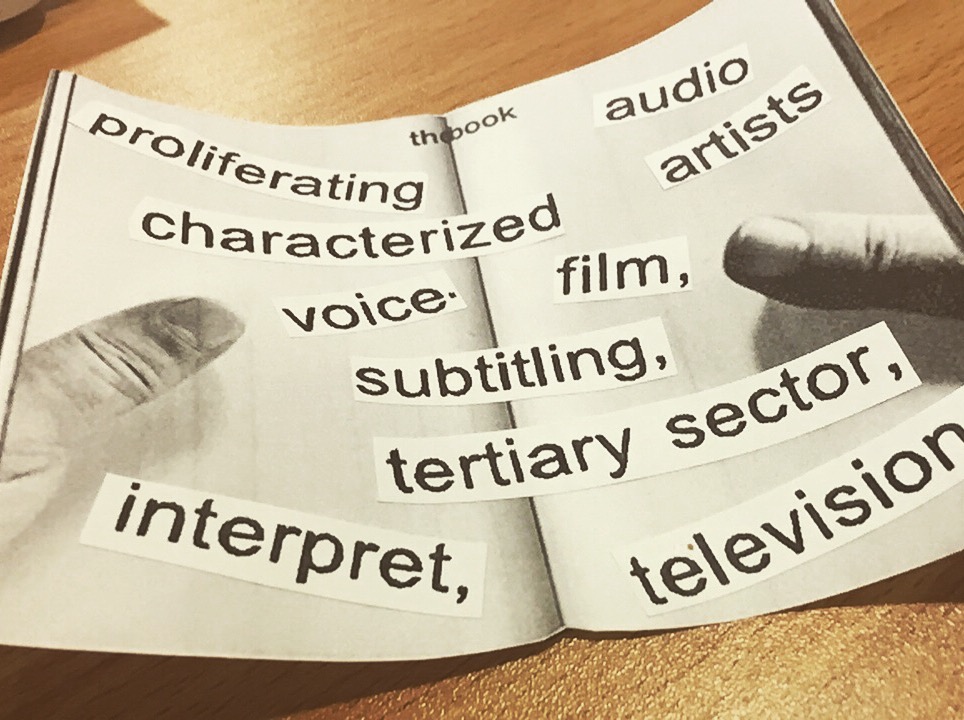
      Following from my earlier lecture, I had a seminar that focused on a more hands on approach to postmodernism. 'Cut up' is a popular style we, in groups, used to create our own unique outcomes of existing images/type. The range of printed extracts were there for us to cut out and post-produce, using different parts to create a larger piece of art. We changed the original piece using processes of deconstruction, intervention, layering, concealing, revealing, repositioning, enhancement, embellishment, destruction and creation. I have photographs below, displaying some of the work my group produced. I love workshops that are hands on and productive. Experimentation was the key learning technique throughout this hour, using a range of resources to create your own outcome. 


      \